
When the Central Bank of Nigeria (CBN) launched AfriGO on January 26, 2023, the pitch was bold and symbolic. Nigeria, Africa’s largest economy, was launching its own domestic card scheme, one designed to reduce dependence on foreign payment networks, cut transaction costs, protect data sovereignty, and deepen financial inclusion. With the launch, Nigeria joined countries such as India, Russia, and Turkey that operate government-backed domestic card schemes as part of their national digital infrastructure.
Three years on, AfriGO sits at a critical crossroads. According to the Nigeria Inter-Bank Settlement System (NIBSS), over one million cards have been issued nationwide, and transactions have surpassed N70 billion by September 2025.
While partnerships with banks and fintech companies show strong institutional support, public awareness and everyday usage remain limited. The key question today is no longer why AfriGO exists, but whether it is delivering real value to Nigerians.
WHY AFRIGO WAS CREATED?
AfriGO was conceived as more than a payment card; it was designed as a structural intervention in Nigeria’s financial and digital ecosystem. Before AfriGO, most card payments in Nigeria relied on foreign networks. This meant that transactions were processed outside the country, exposing banks and merchants to foreign exchange risks, higher fees, and delays. It also meant that sensitive payment data was stored and processed abroad.
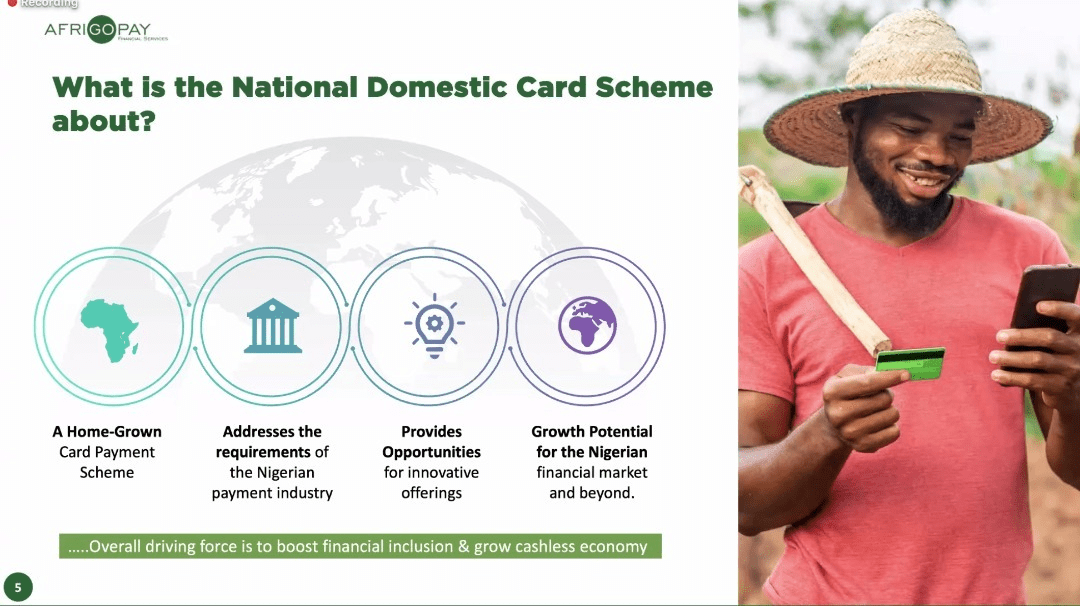
AfriGO flips this model by processing transactions locally, in naira, reducing dependency on global networks and ensuring that payment data remains within Nigeria’s borders. Beyond economics, AfriGO was framed as support for Nigeria’s digital payment rail within the Digital Public Infrastructure (DPI).
Digital payments form one of DPI’s three pillars, alongside digital identity and data exchange. By creating a domestic card scheme, the CBN aimed to anchor Nigeria’s payment rails in a sovereign system capable of supporting government services, digital ID integration, and financial inclusion initiatives.
FASTER SETTLEMENTS AND SUPPORT FOR SMALL BUSINESSES
Another major goal of AfriGO was to improve how merchants receive payments. Many small businesses experience delays in card payments being credited to their accounts, which can disrupt daily operations. AfriGO guarantees instant credit for point-of-sale (POS) transactions. Premier Oiwoh, NIBSS managing director and chief executive officer, described this feature as central to early adoption. According to him, AfriGO is currently the only card scheme that enables instant credit on POS transactions. Financial inclusion was another explicit goal. AfriGO is designed to function across ATMs, POS terminals, agents, and offline environments, with the intention of serving rural communities, informal traders, and low-income earners
Speaking at the virtual launch of the scheme, Godwin Emefiele, former governor of the CBN, framed AfriGO as a corrective to gaps left by Nigeria’s cashless policy.
“The scheme is important to plug the gap that has remained in the economy since the introduction of the cashless policy, and will integrate the informal segment of our economy, reduce shadow banking, bring more Nigerians into the formal financial services with an attendant diversification of deposit portfolio, which will further strengthen the stability of the banking industry,” he said.
AFRIGO’s ROLE IN NIGERIA’S DIGITAL PUBLIC INFRASTRUCTURE
AfriGO was also designed to work with other national digital systems. It is meant to integrate with the e-Naira, Nigeria’s central bank digital currency, and with national identity systems. Some partner banks offer zero-maintenance accounts and/or activation bonuses linked to AfriGO cards, while fintech partnerships aim to scale access for underserved users. NIBSS has disclosed plans to embed AfriGo into the National Identity Management Commission’s multipurpose identity card. NIMC recently launched the General Multipurpose Card (GMPC), which combines identity credentials with debit or prepaid payment functionality, biometric authentication, access to government social intervention programmes, and ECOWAS travel features.
To expand its footprint, AfriGO has partnered with fintech companies including Moniepoint, PalmPay, OPay, and Flutterwave. These collaborations aim to deliver affordable, secure, and instant payment services to underserved Nigerians. AfriGO has particularly announced partnerships with Moniepoint and PalmPay to issue more than 10 million AfriGO debit cards nationwide, alongside the rollout of tap-to-pay solutions to support contactless transactions.
“The Moniepoint/AfriGO card is not just a product; it’s a vital tool that will extend our reach, particularly to those traditionally excluded from the formal financial system,” Tosin Eniolorunda, chief executive officer of Moniepoint Inc, said in April 2025. These efforts align with the federal government’s goal of onboarding more than 20% of Nigeria’s unbanked population.
AWARENESS REMAINS A MAJOR CHALLENGE
Despite these partnerships, awareness of AfriGO remains low among everyday users.
Ebehijie Momoh, managing director and chief executive officer of Afrigopay Financial Services Limited, told New Telegraph in 2024 that 25 banks were already issuing AfriGO cards nationwide. However, interviews with traders and small business owners suggest that many Nigerians are still unaware. In Ilorin, Kwara state, interviews with 40 traders across the Ago, Oja Oba, and Oja Tuntun markets found that none had heard of AfriGO. A similar pattern emerged in Ikorodu, Lagos, where 15 small business owners in the Mowo-nla area of the community were unfamiliar with the card. In Ilobu, Osun state, all 10 business owners interviewed also had no knowledge of AfriGO.
This gap highlights a common problem with digital reforms in Nigeria; systems are introduced at the policy level, but adoption at the grassroots level is slow. Without sustained public education and visible use cases, AfriGO risks remaining largely invisible to the people it is meant to serve.
SCALING AFRIGO NATIONWIDE
To expand its footprint, AfriGO has partnered with fintech companies including Moniepoint, PalmPay, OPay, and Flutterwave. These collaborations aim to deliver affordable, secure, and instant payment services to underserved Nigerians. AfriGO has particularly announced partnerships with Moniepoint and PalmPay to issue more than 10 million AfriGO debit cards nationwide, alongside the rollout of tap-to-pay solutions to support contactless transactions.
“The Moniepoint/AfriGO card is not just a product; it’s a vital tool that will extend our reach, particularly to those traditionally excluded from the formal financial system,” Tosin Eniolorunda, chief executive officer of Moniepoint Inc, said in April 2025. These efforts align with the federal government’s goal of onboarding more than 20% of Nigeria’s unbanked population.
AWARENESS REMAINS A MAJOR CHALLENGE
Despite these partnerships, awareness of AfriGO remains low among everyday users.
Ebehijie Momoh, managing director and chief executive officer of Afrigopay Financial Services Limited, told New Telegraph in 2024 that 25 banks were already issuing AfriGO cards nationwide. However, interviews with traders and small business owners suggest that many Nigerians are still unaware. In Ilorin, Kwara state, interviews with 40 traders across the Ago, Oja Oba, and Oja Tuntun markets found that none had heard of AfriGO. A similar pattern emerged in Ikorodu, Lagos, where 15 small business owners in the Mowo-nla area of the community were unfamiliar with the card. In Ilobu, Osun state, all 10 business owners interviewed also had no knowledge of AfriGO.
This gap highlights a common problem with digital reforms in Nigeria; systems are introduced at the policy level, but adoption at the grassroots level is slow. Without sustained public education and visible use cases, AfriGO risks remaining largely invisible to the people it is meant to serve.
PROGRESS, BUT NOT YET TRANSFORMATIONAL
From a user’s perspective, AfriGO is intended to function like a regular debit card, with access to ATMs, POS payments, and basic financial services. Some users, however, say their experience has been underwhelming. Adedayo Ade-Rufus, a Lagos-based journalist and SEO expert, said he stopped using the card shortly after obtaining it.
“I got the AfriGO card around September 2025. I saw it in my Sterling Bank app and thought I’d try it since I wanted a debit card. I think it was free or maybe discounted, but I can’t remember exactly. I asked them to deliver it to my house, which wasn’t difficult,” he said.
“I tried to use it to credit my internet service provider, but it didn’t work — maybe because of restrictions on Naira cards. I was discouraged, and I didn’t use it again. It didn’t change the way I make payments; I just went back to my usual bank transfers.”
Experts agree that AfriGO is an important piece of national infrastructure, even if its impact is still limited. However, analysts caution that card schemes do not succeed on infrastructure alone. Adoption, they argued, depends on coordinated incentives, clear policy mandates, and sustained public communication. They also noted that Nigeria’s large unbanked population means many people have little or no use for a bank card at all.
In 2025, Ibukun Akintade, a POS consultant and finance analyst, offered a measured assessment of AfriGO’s progress, nearly two years after its launch.
“Nearly 18 months later, the question is no longer ‘Why AfriGO?’ but ‘How well is it really working?’ What has worked so far includes faster, cheaper local settlement for banks and PTSPs, better control of user data enabling targeted regulation, early-stage POS integration by major players, and revenue retention by reducing outflows to international scheme fees,” he said.
Akintade, however, warned that structural gains alone are not enough to guarantee widespread adoption.
“But there are real challenges: banks are slow to adopt, merchant acceptance is low, customer incentives are weak, and brand visibility is minimal, especially outside Tier 1 cities. AfriGO has potential, but to truly disrupt payments, it needs commercial value for banks, trust from merchants, and rewards for cardholders,” he added.
Similar concerns were raised in a 2023 analysis published by Dentons ACAS-Law, which examined the broader implications of the CBN’s decision to introduce a domestic card scheme.
“It is without doubt that following the rise of e-banking platforms by fintech startups in Nigeria, the CBN’s pioneering of this domestic card scheme is sure to catalyse greater innovation for payment systems in the private and public sectors,” the analysis reads.
They, however, questioned AfriGO’s ability to significantly advance financial inclusion under current conditions.
“The CBN has stated that AfriGo will improve financial inclusion as card charges will be reduced in comparison to those issued by foreign payment service providers. However, the cards will only be available to those with bank accounts, and those without them remain unaccounted for,” it added.
“The CBN has stated that AfriGo will improve financial inclusion as card charges will be reduced in comparison to those issued by foreign payment service providers. However, the cards will only be available to those with bank accounts, and those without them remain unaccounted for.
“As such, it is not clear how the introduction of the AfriGo cards will substantially increase financial inclusion, being that a notable portion of the population is ‘unbanked’, thus having no use for debit/credit cards.”
Three years after its launch, the real test for AfriGO is no longer technological. It is whether Nigeria can translate digital infrastructure into everyday value and ensure that public systems serve people, not just policy goals.
First published on The Cable